Wednesday, 18 April 2018

Identity lost or Identity gained ?


Having lived like a nomad for the last few decades, the feeling of belonging is often lost and the borders seem to have blurred significantly in terms of our behavior, our values and our thinking overall. There are times when distinctions such as culture, gender, color, nationalities seem pointless and like I have stated in one of my previous blogs, the human need to identify oneself through differences seem frivolous. The more I meet people from different backgrounds the more I find them similar in the core. Sure, cultures, nationalities, accents and looks differ and these aspects do have an effect on relationships. However, it appears that a new bubble of community is formed under this category of people, which we can categorize as the nomadic or the hippies of the new world. In other words, they are the "Expatriates”.

During many farewell dinners with many friends from this bubble of expatriates we have discussed the perils of re-integration that are required for those returning back home. Sometimes happy but more often nervous to be able to adapt to the very same world where they were born and brought up. In a foreign land these same people tried so hard to maintain their identities from home and once back home they find it difficult to adjust to what they once called home.

Ironic as it appears, the transformations of human ideologies with reference to place and environment is natural. Our instinct to adapt to our habitat has been ingrained through evolution. Stepping away from our home countries and cultures brings new perspectives to our outlook, open us to new ideas and points of views. Living as an expatriate broadens our horizons of the range of possibilities of living your life. This makes it difficult for us to go back to our own home countries and fit in. Many of us do go back and like to be close to our own but once an expatriate always the odd one out. I have heard many Swedish friends tell me how out of place they feel coming back to Sweden after their long haul abroad, many Americans are nervous to be back home and many Indians who are back in India but are always looking for cross cultural communities. The sense of a reverse culture shock is a growing phenomenon. 

Should we call this a loss of identity or gaining a more heterogeneous identity? Have we stepped out of the comfort of our widely perceived nationalities or have we stepped into the comfort of the new global citizen ? Our children are growing up in mixed communities that speak many languages, have different hair, eye and skin coloring and perhaps have contrary cultural beliefs. Do these differences make them more tolerant toward each other or will it generate more prejudice ? Will such a multiple exposure to communities and countries make them see the world as a single entity or will they begin to segregate it. Will this international cult of children turn into Aliens, Intellectuals, Visionaries or Freaks ? Is this world ready to embrace differences or generate further divides ?

It remains to be seen which direction our future generations will take as currently the world  ideology looks a bit confusing to me. The post war liberalism has forgotten its lessons already and reverted to conservationism. India’s much proclaimed post war secularism has turned into a traditionalist by banning ‘beef' for its citizens. The making of the European Union embraced globalization and yet the referendum in Britain resulted into the Brexit. Just a few years ago USA welcomed a colored President and now it speaks of creating hostile walls bordering Mexico. If this world is going to take one step forward and two backwards it will be a long time before our children can feel at ease with their new forms of identity.

The world appears to be standing at the crossroads of deciding its own identity, a humanity  that breeds through love and a cohesive progress or a humanity that is segregated through the disparity of hate and conflict.

Thursday, 5 April 2018

Facebook: The Reality of Fiction

I have been a Facebook (FB) user since 2007. Having lived in far away places from friends and family, FB became a tool to show and tell. My daughter has almost grown up on FB, videos and pictures of her first steps, her moods, her Christmas, Diwali and Halloween costumes, her school performances, her pets, her hairstyles, places she has been to and her friends have all been shared with my family who lives two continents away. We are grateful to have such media tools available to us to keep us in touch with the lives of our near and dear ones. Facebook has also helped me connect with long lost friends from the neighborhood, from the early school days, from the ones that drifted away from college and colleagues from the various companies and countries we worked in. I am a peoples person and I like to see and hear about people I know, on Facebook I enjoy the occasional virtual overview of my family and friends. Facebook has enjoyed the patronage of such sentiments and grown to an active user base of over two billion as of 2017 figures.

I often receive notifications from Facebook reminding me of my memories, my friendships and sometimes the gestures are heartwarming when FB makes lovely videos to celebrate these memories. Now, with a population of over two billion users it is naive to think these gestures of good will are personally handled by humans. Zuckerberg in fact takes great pride in how advanced and state of the art their systems are that he presented his Facebook vision of around the clock augmented reality with sensors, camera, and chips embedded in clothing, everyday objects, and eventually the human body. So, I can safely assume that the lovely videos which almost seem tailor-made for me are the work of astute algorithms which are programmed to take the feed from my wall posts and design the pre-formatted animated videos.  In one such memory reminder, the video acknowledged my four year old friendship with a Danish friend, the algorithm promptly displayed a white animated figure embracing a brown animated figure.

On the one hand, I appreciate the precision of the algorithm to grasp such a detail and on the other hand I am spooked out about so much precision. This got me comparing the real world scenarios with virtual scenarios. Surely, we give away more information than we intend to through social interactions in the real world however in the virtual world such information is archived and can be retrieved for or against your will without any emotional obligation.

We have been warned by security technologist Bruce Schneier that, “Facebook can predict race, personality, sexual orientation, political ideology, relationship status, and drug use on the basis of ‘Like’ clicks alone. The company knows you’re engaged before you announce it, and gay before you come out and its postings may reveal that to other people without your knowledge or permission. Depending on the country you live in, that could merely be a major personal embarrassment or it could get you killed.”

Besides how the users of Facebook or any other social media may feel at a personal level, Cambridge Analytica has shown us the horrors of political misuse of Big Data and the extent of manipulation it is capable of. Facebook has compromised personal data of 87 million of its users in the United States of America to manipulate the electorate, so how different is this real life trepidation from the story of the Black Mirror episode, “The Waldo Movement” (2013) where a cartoon character takes over the country leading it to a state of anarchy.

The next few decades of human computer interaction enters its most radical phase as the world is poised to slowly transition in the age of calm technology (Weiser,1988) wherein devices will disappear and a digital layer envelops us in our day to day lives. Currently we are choosing to post our pictures on FB and Instagram or express our thoughts through Twitter. Shortly, information may be grasped about us by just being in any digital environment. The prediction is that as we plunge into this third paradigm of the ubiquitous matrix of media and communication, our near future digital lives will be spinning off exponential more intimate data (Nardi et.al., 1999). We have seen the precision with which algorithms can customize and design desired outputs. We have seen how successfully  Cambridge Analytica has managed to analyze Big Data and manipulate the elections in USA. It is only a matter of time before Artificial Intelligence starts to predict the sub conscious patterns of human behavior and the fictional story of “Her” (2013) becomes a reality. 

A large part of FB users may still be oblivious to how their privacy is compromised, but let us not be complacent to the possibility of horrors that the advancement of technology can bring.

Monday, 10 October 2016

Brand XXX


The self proclaimed capital of Capitalism goes to elections next month and I cannot but help to analyze the paradox faced by the country which has conditioned its citizens to the frivolousness of its own capitalistic thinking.

The campaign holds up the “sleaziest brand” of the century and comes up with the most mundane media strategy of creating controversies through “sex lies and videotape” to generate eyeballs (television ratings) and social media discussions. For the lack of any creative energy the communication strategy is a straightforward repetition for an “easy sleazy” brand recall. And in spite of such a nagging media presence when the going gets tough and the brand begins to feel insecure it creates the most childish diversion through a two pronged defense strategy of “counter malice” and a “continuous whine”. Not to mention the constant interruptions, but then like I mentioned earlier this is a part of the capitalistic upbringing. 

Now, now let’s not get carried away under the wave of capitalism and attribute some credit to the public for checking on the brand’s quality. We use the most modern technologies to analyze the performance of such an “X rated brand” and Voilà, it’s not a surprise, the brand is being talked about not just in the political world but across all the segments, entertainment world, news channels, corporate world, academia, social media and even the Tupperware parties. Now this is what a majority of marketing campaigns aspire, any publicity is favorable to no publicity. So, with a marketing mindset if a “Brand XXX” is so much talked about, even if unfavorably, a percentage of users are willing to give it a try, if nothing maybe just out of curiosity. And, the statistics are much higher than you and I would like to believe.

In fact, many marketeers will agree with me that an appalling number of companies have made a fortune selling sub-standard products like the 'wonder-mop' that don’t work in reality but have been sold in large numbers through such a repetitive and/or controversy driven campaigns. In a capitalistic world money needs to circulate, the more the companies make people spend, the better the country’s economy performs.

This is United States of America’s moment of truth as the citizens vote their new brand of leadership, the outcome of these elections will tell us how the majority of Americans think. Are they conditioned to think like the "Capitalistic Brand Rhetoric" that I have outlined above or do they have the depth of reason and are able to see through that they are subjected to an extreme form of  "Media Sensationalism". I do hope for the latter. 

Thursday, 5 May 2016

The Great Swedish Immigration


Sweden thrives to the image of being world’s ‘Moral Superpower’. That is probably the reason why the media here is very careful in reporting the dilemma and the near collapse of this ‘welfare state’ (IPC).  Since our move here nearly a decade ago, as work migrants I have noticed the changes in the landscape of the city of Malmo which is the largest entrance and a migrant port due to its location at the tip of south Sweden.

The Welfare system of the country is so generous that a registered refugee receives almost to the equivalent of 700 dollars monthly allowance, in addition to a neat accommodation in the growing Swedish ghettos. Moreover, Sweden takes in more refugees per capita than any other European country.  A majority of asylum seekers are from the war torn Middle-East and Africa which constitute about 16% of the population. However, during the recent Syrian crisis when the refugees were freely allowed to enter Sweden, it has been reported that less than half were actually from Syria and a majority were from Iraq and Afghanistan and even from countries which are not at war.

The latest statistics show that more than 20% of the total population in the country’s inhabitants has full or partial foreign background. The country is becoming so homogeneous that not only the words “immigrant” and “refugee” are blurry in it’s meaning but it is also feared that at this rate the Swedes themselves will become a minority in the next 10-15 yrs.

Such an idealistic state with porous borders is perhaps a great example in humanitarian terms. However, sustaining such high morals in mathematical numbers is bringing a collapse of the welfare system explains the economist Sanandaji. The welfare system is currently working on the phenomenal taxes the state collects from the employed. Nearly 58% of welfare payments go to immigrants. Whereas, the biggest employment gap in all of Europe exist in Sweden as nearly 48% of young immigrants are either unemployed or choose not to work. A majority of criminals charged with robbery, rape or murder are first or second generation immigrants. A country that prides itself in integrating these immigrants has clearly bit into more than it can chew. The crime in the country is on a rise, unaccounted refugees and unaccompanied refugee children are absconding, vandalism in the refugee ghettos is unmanageable and police and the authorities are short staffed to handle it all.

And yet somehow the nonchalant Swedes continue with their everyday routines without a hint of worry. Except perhaps that when we arrived nearly a decade ago, everyday discussions often revolved around the subject of fickle Swedish weather, these discussions are now often marred with the incidents of muggings and robberies. The irony is that on one hand Sweden welcomes asylum seekers to soak up the country’s welfare benefits and on the other hand tax payers like us have trouble in getting visas for visiting family members.

In 2014, Danish historian prophetically remarked in the book "Farliga Ord” (Dangerous Words), that the economic breakdown of a nation always happens quickly and unexpectedly:

"If there is any lesson to be drawn from history, it is that what you do not think will happen, does. Time and again. The final consequence of the West and, above all, Sweden's immigration policy is that the economy will collapse because who is going to pay for it all? 
And economic breakdowns, once they happen, always happen very fast.”

Tuesday, 13 October 2015

Identifying the Politics of Identity


A majority of countries today are struggling with the horrors of their own creations. Since the beginning of the world we have learned to congregate into groups of distinction. Humans, animals, insects and things are often classified based on their looks, compositions, habitats or habits. It has been our fundamental need to segregate, divide, classify, categorize and label through differences and disparities.

We have supposedly evolved in our bodies and our brains but our minds continue to inhabit this very fundamental human need. On the contrary our minds have evolved its capacity of registering the infinitesimal differences to manifest into a colossal suffering. Now we have learned to stress ourselves with imagined distinctions to haunt us so much that we have lost the capacity of all other senses. Such is our overpowering need to differentiate that we cannot see, hear, touch, smell, taste or feel the similarities of our fellow human beings. Our desire to rule and to dominate is so great that we have fashioned differences to create fake identities through colors and nations and ethnicity and professions and in the process we are now so fragmented that we have lost one of the most distinguishing trait of being a human, the capacity to feel empathy and compassion.

Defining and redefining our identity is hence a political tool to obtain and retain power, the sooner we differentiate these differentiation the faster we evolve ourselves out of permanent self-destruction. If not, the only hope that we will be able to see similarities once again among fellow humans on this earth is perhaps if we were to be attacked by a common enemy such as Aliens from a distant cosmos. If these Aliens are more evolved than us humans that will be the final blow toward permanent destruction of all our collective identities - the relish of most power brokers - the so-called doom’s day. Amen.

Tuesday, 21 July 2015

Kenyan Wahindis


My earlier trips to Kenya were mostly marked with social hobnobbing amid my sister’s family in addition to the game spotting of Kenyan wilderness. However, this summer my experiences in Kenya extended into the deeper sociological composition, which frame social hierarchies establishing a kind of human food chain, predominantly built on skin pallor.

Since Kenya and India were both British colonies in the early 1900’s the British indentured Indians as skilled labor to build the railway lines in East Africa. The railway lines were laid through the dangerous jungles by sacrificing 2500 Indians to the notorious Tsavo man-eaters. These were the earliest Indian settlers in Kenya some of which still reside along with their families for over 5 generations.
 
Kenya’s elevated city Nairobi privileged with temperate climate and favorable agricultural land was during those times predominantly a white-settler town where the local blacks were not permitted to live. However, Indians fought for their rights and were eventually legally allowed to reside in Nairobi. Similarly, Indians also demanded political representation from the British based on their economic clout however; both prevented any representation from the local Kenyans.  

Currently, although the Indians constitute less than 1% of the total Kenyan population they are integral to Kenyan economy and politics. Indian Gujarati’s and Punjabi’s dominate businesses, trade and commerce and have flourished together with the Kenyan economy. Since, Indians own approximately 30% of all businesses, it is a common sight to see Indian business owners employing local Kenyan workforce.

Indian Diaspora in Kenya is brilliantly represented through Naipaul’s book “A bend in the river” wherein, the KenIndians known as Wahindis in Swahili live in a closely guarded bubble of their religion, language and culture, which is surprisingly endogamous and close-knit in spite of over a century of settlement with the Kenyans. From the Kenyan perspective the Indians are no different then the Colonial powers of injustice and exploitation and this resentment has often taken form of violent crimes.

Nevertheless, KenIndians felt a brunt of causalities during the Westgate siege in 2013 by the Somalian Islamist Group, since the mall is located in the affluent Westlands area of Nairobi often frequented by the Indian Diaspora and nearly 60% of the business owners in the mall were Wahindis. 19 of the total 68 casualties were from Indian origin. And as observed often, occasions that involve a common enemy tend to unite the diversities. There are many stories of how the Kenyans and the Wahindis faced the Westgate crisis together and helped each other during the siege and after.  

The question is weather we require crisis situations for globalization to be truly realized? Will we continue to live in little bubbles of our cultures and identity and looking inward in spite of where we live? Is there any hope for humanity to exist as a whole by shedding our differences and taking inspiration from each others strengths?

Sunday, 3 May 2015

Observing Media Patterns of Children

-->


"The 21st century will not be a dark age. Neither will it deliver to most people the bounties promised by the most extraordinary technological revolution in history.
Rather, it may well be characterized by informed bewilderment."
Castells (1999)

Author of the book, “Rise of the Network Society” Manuel Castells in his interview with Gestner of ABC mentioned that, “The information technology revolution is about how we generate and process information. And information is the key substance of all human activity, and is directly related to culture, to institutions, to experience. So for the first time there is a direct connection between what we think, what we believe, and how and what we produce. Minds become the direct productive forces, and minds are rooted in culture and in social relationships. So there is interactive connection, for the first time, in real time, between nature and culture, through information processing enacted at the speed of light”.

21st Century infants soon as they develop some basic motor skills begin to patter on mobile devices, haptic experiences of babies and toddlers have been nurtured by tablet touch screens. By the time, children start school they begin to meaningfully use media devices using their smart phones to vote, to play, to chat or to find information. Modern day children are embedded into new media technologies and are setting the trends of media consumption patterns. You Tube mash-ups, Minecraft building blocks and Wikipedia information are already shaping the modern pedagogy. In times when the boundaries between recreation and information are blurring, children are not only consuming media but also actively creating media content.

I have often noticed two extreme sets of discourse toward children’s media consumption patterns. On the one hand there is a pessimistic discourse wherein, children + media = parent anxieties in terms of medias adverse effects on the child’s health, safety and security. On the other hand, often driven by commercial interests, children are idealized as a source of hope and progress whose imagination and creativity are the foundation of the future of a society.

I am however interested a third strand of discourse which is neither pessimistic not idealistic but encourages the young to be included in the discussion and to be taken seriously in terms of how media experiences are offered to them or preferred by them which transpires the culture of the society to be able to be develop them into ‘well-rounded-individuals’.

I propose to take up this subject toward a long doctoral thesis, however my primary motivation for understanding these patterns builds on an everyday struggle with my 10 year old that depends on social media and technology for a majority of her chores. She learns to play the musical notes of her favourite songs on the Keyboard through You-tube videos, finds information regarding her favourite movie stars and pop singers through imdb or Shazam, creates movie videos with her favourite toys on imovies and makes cyber buddies and pen pals through her Vlog channel, she also practices her Mathematic equations through an internet site, Matheletics and researches for her school projects through Google. After a long stroll on the beach or an involved summer afternoon in a park watching the ducklings, she soon comes back to her ipad to find out more regarding the changing tides or the different varieties of swans and ducks. Curiosity of today’s child need parents with the knowledge base of Google and Yahoo, so perhaps if she is not referring to it directly eventually we parents are directing her to find her answers on the internet. With such an overwhelming influence of the media on today’s children, it may be vital to consider its presence not in the background of their lives but rather embedded into their lives. 

Often marketers have used the term ‘catch them young’ to grasp the pristine and undivided attention of children and adolescents toward capitalistic and brand building motives. In the digital age additionally children are exposed to a variety of windows, which can make them wiser faster and/or can also expose them to a variety of threats and challenges in an effort to keep up with the pressures of the fast changing world. Digital media has become part of their academic curriculum and online games and digital apps have become integral to learning pedagogy. Most parents have to perform a tight-ropewalk between maintaining the digital media diet and allowing a healthy growth of knowledge and media skills. These are times for both parents and the young ones to tread the cyberspace with an informed and a poised comportment. By alienating children from such decision-making however is beneficial to neither. Hence, my constant endeavor is to understand the world of children as they are experiencing it and not just by proxy of what the parents choose for them.

Tuesday, 21 April 2015

Night Crawlers - Media Sensationalism


My advertising career has been marked by clients spending big money in mass media toward getting favorable publicity from the media and more often than not I have witnessed that such obligations are intricate which are frequently compromised debating media’s journalism ethics. The concept of media commercialization is not unambiguous. Journalistic content has often been market-adjusted that is often trivialized, tabloidized and sensationalized. Journalists have started becoming celebrities through image creations and media companies are driven more by commercial interests than journalistic ideals. Increasing competition toward gaining eyeballs has diverted the editorial focus on the audience rather than the news.

The movie ‘Night Crawlers’ portrays such a commercialization of American media. Director Dan Gilroy paints a gory, bloody and a very graphic image of media sensationalism, giving a very real picture of media practices which often the general public is oblivious of. Unemployed and desperate Jake Gyllenhal teams up with the blood-sport veteran, TV channel director Rene Russo to not just cover the crime in the city but also generate situations that can create the sensational crime news. In the breakneck, ceaseless search for footage, they both flourish along with the TV Channel as police siren equals a possible windfall and victims are converted into big bucks.

Once again I hint at the reality of fiction, as on one hand the extreme portrayal of such sensationalism maybe viewed as possible only in fiction and yet there is evidence that wars have been waged over such yellow journalism. The changing media landscape of digitized dialogue versus the old-fashioned mass media monologue has often been celebrated and yet the power of mass media continues to hold us ransom to such gory sport of blood. In my opinion, fictional tales such as ‘Night Crawlers’ warns us to be vary of our patterns of media consumption and perhaps hints us to alter our habits of media use, pointing more toward pull rather than the push structures.

Monday, 6 April 2015

Aesthetics of Poverty

I was depressed and visibly shaken while reading Katherine Boo's latest book "Behind the beautiful forevers" in which she is harshly depicting the slums of Mumbai city which is based on the lives of real people - a fictional tale based on her ethnographic research for over three yrs of these shanties. I have lived in Mumbai and have observed the conditions of these slum dwellers and have always felt helpless to see the contrast of the lifestyles of the city's extreme rich and the extreme poor. What left me wondering however is the reason for being so depressed and shaken; "Was it the reality of the fiction or the fictional portrayal of reality!!"

Davidov (2013) in his article regarding "Ethnographic Fictions" suggests that, "whether one looks at the discourses of development in fiction, or discourses of and around development as fiction, one must consider what these fictions reveal or conceal on a meta-narrative level, even as they may become fluid and transformed through circulation".

Representations in media have profound effects on the lives of the people portrayed, some of these media productions are designed with an objective in mind, such as humanitarian aid, attention to development and social change and at other times subconsciously they simply reinforce or create stereotypes. 

To quaver my psyche into understanding why i think Katherine Boo's depiction is dry and harsh,  I revisit my own media analysis of another similar transition between fiction and reality of the movie 'City of God' (2002) depicting a Brazilian favela based on a book by Paulo Lins (1997) and a true-life story of a little boy named Alexandre Rodrigues. 

My intention in the analysis of 'City of God' was to plough-up a fertile ground that may help to construct an alternative view and perception of issues such as poverty and human rights, which are often wedged in western hegemony and politics of power. I had made an attempt to address the intersection between, fiction, development and post-colonial studies under the title ‘Aesthetics of Poverty’ a term widely attached to the Cinema Novo genre of film-making, which originated in Latin America toward social equality with a participatory ideology. 


‘Cidade de Deus’ directed by Fernando Meirelles is a not rhetoric of oppression to create pity and attract humanitarian aid. It is an attempt to publicize a jarring counter image of what the world knows about Rio and what more Rio has to offer than sun, sand and beaches. There are many documentaries
and cinema novo films made to this purpose, however the reach of popular cinema and the creative genius of the director and his team toward creating ‘Cidade de Deus’ which has won many accolades internationally has certainly helped to achieve a great level of publicity toward bringing Rio’s underbelly to the worlds notice.
Almost the entire cast of 200 actors for the film were recruited and trained for acting from the favelas of Brazil, moreover the film has been shot in a nearby favela (less dangerous compared to Cidade de Deus) and in the original Portuguese language by a Brazilian director. Hence, the film has consciously maintained the authenticity of characteristic mannerisms, lingo, psyche and milieu. It can be compared to what Spivak (1988) cited in McEwan (2009 p.73) calls the ‘native informant’. The film hence narrates knowledge situated within the favela, as McEwan (2009, p.35) explains, “what counts as knowledge determines, who creates it, where it is generated and how and for whom it is disseminated”.
The narrative is neutral and candid, however the director does take liberties toward creating larger than life image of a psychopath such as Li’l Ze to alienate a monster and hence create the classic good vs evil story line. Consequently, the binaries of white and black, rich and poor, male and female, the educated and uneducated are also clearly apparent in the narrative. The scenes contrasting the urban slum with the affluent urban city are very few, such as the office, the super market where Rocket works. However, they accurately represent the juxtapositions of enormous GNP’s alongside of extreme poverty in Brazil. These scenes clearly portray race inequalities with majority white population in the urban city versus the majority pretos (blacks) in the urban slum. Moreover, women are mostly shown in the background and have no major role-play except for the purpose of sex in the favela, whereas the urban city office shows many white women at work. Conversely, if you follow
the storyline, most of the men feel doomed to live the favela life, unless women salvage them, to live better lives outside of crime. This is an alternative way of unpacking the plurality of feminist roles challenging western assumptions (McEwan, 2009, p.57-59).
Nonetheless, these representations of cultural pigeonholes are deliberate intentions of the director toward his overall objective of depicting bare, raw and earnest reality. Since, a majority of the actors starring in this movie were residents of favelas, the production team attempted to relocate them to safer areas, giving them opportunities of work and provide them with education and improved living conditions.
However, a research after 10 years of the film’s success suggests that out of approximate 200 actors, most of them insisted on living in the same neighborhood along with their family and friends, some have continued with their acting careers and many continue with their original lifestyle. Nevertheless, this genre of movie making, which is not only an artistic expression and a communication medium but also extends itself in to becoming a developmental project through local participation leads us to an interesting dialectic regarding the blurring boundaries between facts and fiction.

References:
Davidov, V., (2013) 'Pedagogical’ and Ethnographic Fictions and Meta-narratives of
Development: 1 World Manga, Journal of Development Studies, Vol.49, No.3, 398-411.

McEwan, C., (2009) Postcolonialism and Development. London and New York:
Routledge.

Wednesday, 25 February 2015

Information Couture

Tailored and customized clothing designed to fit your body contours is often referred to as "haute couture".  Eli Pariser  opens our eyes to what he calls the 'filter bubble' wherein the modern day digital algorithms seems to be snipping, cutting, contouring and filtering out information for each one of us like haute couture. He gives examples of Google's search engine which decides what information caters to your interests and other social media channels such as YouTube and Facebook customizes the feed as per the digital understanding of your personality, likes and interests. Such tailoring sounds fine as long as you agree to remain in the customized bubble created especially for you but that defeats the definition of the Internet which promised to connect us to the world wide web.

However, one can argue that the world wide web information is enormous and hence it is inevitable and perhaps even intelligent to create a digital bubble which caters to our personality and interests. What one needs to then question is the integrity and authority of such tailoring which seems to assume the power of couturing for us as per their assumptions of our vital statistics. Furthermore these vital stats have a potential to change and does this couture culture allow such a change? Inventor of the world wide web Tim Berners-Lee himself is concerned of this couture culture and compares it to the Eagles number 'Hotel California', where you can check-out anytime you like but you can never leave.

James Smythe in his short story, “Trapped in a vortex of their own trivia” creates a hypothetical situation in which a user fails to realize that a war has broken out, because his internet feed simply supplies him with endless reviews of war films. Is it possible for us to break free of such a matrix, how can we be more vigilant of what information about us is becoming public or that we are going to be judged by. Are the current privacy settings and choices on the social media and search engines enough to prevent such a scenario? Can we become smart enough to construct a desired data-mining avatar that fits our needs? There are proxy servers such as "hide my ass" and secured 'https' and cached browsing patterns which hides your digital footprint as illustrated by Colin Jacobs however it is not established how much is still visible to powerful data-miners such as Google. Julian Assange's statement that, "the Internet is the greatest spying machine the world has ever seen" sounds appropriate to describe such an "Information Couture".


Saturday, 27 July 2013

“Eat”ly A wonderful country of rich history, warm people and scrumptious food.


Once upon a time two little twin boys, Romulus and Remus were abandoned by their parents along the river Tiber – it was a female wolf who nursed and raised the children and then an entire empire that spread around the Mediterranean across three continents was named after one of these twins. Welcome to the city of Rome’ance, named after Romulus who killed Remus to become the king. A city to eat, pray and love. A lifetime is perhaps not enough to comprehend a place with such rich history and culture.

The city of Rome is a live excavation site, a casual walk through any of the strade and piazza will lead you to discover marvellous art, magnificent sculptures, glorious architecture and infinite ancient stories. It is a place with a living history; some monuments such as the Pantheon and the Colosseum can transport you back in time to nearly 2000 years, into the traditions and the lifestyle of the Roman emperors, their games of treachery and their sport of atrocities.

An artist would take special pleasure at the sight of some of the most illustrious pieces of Renaissance and Baroque styles from the famous Raphael, Michelangelo and Bernini; masterpieces such as the Sistine chapel, Saint Peter’s square, the David in Florence and the many obelisks. The city of Venice is an architectural wonder, often referred to as the floating city whereas Bologna is a city thoughtfully designed with the longest (45 kms) porticos in the world.

The country offers a variety of astonishing tales from the past and just as many culinary varieties to masticate and deliberate upon. Just like the Roman emperors the Italians are fanatic about both gastronomy and astronomy. The Romans travelled far and wide to explore the culinary diversity and bring home the variety of foods, herbs and spices. The origin of pasta has been attributed to the Venetian merchant Marco Polo who got the idea from his travels to China. The Italians have since invented approximately 250 varieties of pasta. A series of ten different cookery books “Apicius” have been written and illustrated to satisfy the appetites of a Roman monarch. The modern day Italians are no different, each region in Italy has a speciality food matching corresponding wines that should not be missed, “Risotto with Bardolino” in Milan, “Pizza with Tuscan Chianti” in Naples, “Tortellini with Sauvignon Blanc” in Bologna and “Cassata with Grappa” in Sicily.

The friendly Italians will love to tell you many interesting stories about their country and their food. It is not unusual that you started to ask an Italian on the street for some directions and landed up having dinner with her family the same evening. Food etiquette is however very essential to all Italians, so please do not make the mistake of ordering a latte post breakfast or asking for ketchup with your pizza, they will not only refuse to serve it to you but you may get a long sermon with fierce hand gestures about how to drink your coffee and eat your pizza, even if you don’t understand Italian. Jamie Oliver once did a cooking show in Italy and was obliged with cooking tips by every Italian on the street.

It might be helpful to get some insider reviews on the country with movies and books such as, Angels and Demons by Dan Brown, The Broker by John Grisham, To Rome with love by Woody Allen and Eat Pray Love by Elizabeth Gilbert. You might be surprised to find out that facts are stranger than fiction.

Monday, 3 January 2011

Wealth Redefined

Dubai is the closest holiday destination from India. Yet I happened to holiday to Dubai for the first time all the way from Sweden only this Christmas.

I did not think the place could astonish me in anyway as I have heard and read a million stories about Dubai. Besides, I have lived in Singapore with which it is often compared.

Nevertheless, being there physically just took the air out of my lungs. This oasis that was barren until the discovery of oil in 1971 had a foreigner population spur of over 300% thereafter. The abundant oil find in Abu Dhabi in spite of Dubai’s love hate relationship with its neighbour led to the formation of the seven UAE states. This makes the region obscenely wealthy. Dubai especially with its glamour image and free trade policies has turned into a financial refuge for the rich and the glitterati.

What the place lacks in sophistication it makes up with its spill of obscene wealth. They have created artificial beaches that are calm and serene. They have reclaimed land constructions to make gigantic villas, which maybe better called palaces. They have built artificial ski resorts and ice skating rinks so that they do not have to travel a million miles to get a taste of a different weather. They have built 828-meter tall towers to feel at the top of the world. They have created a new standard of luxury by making seven star hotels.

The city is on an economic downturn presently and all I saw was giant malls filled with shoppers carrying fancy shopping bags and a New Year firework display that could have fed an entire country for that day. The Sheikhs certainly have their priorities laid out clearly; they punish the criminals severely to make their land safe for none other than the larger and perhaps richer community of the tax invaders. They take hospitality seriously and do not mind going that extra mile to attract the rich and famous. They have managed to work out a win win situation for indulgences in entertainment, experience and the exotic. All in turn to their own benefit.

Sunday, 19 December 2010

The Drama of Life


How often in life have you had that feeling of Déjà vu ? This is spooky, and I have once and again in my life felt that I am experiencing things that I already knew were about to happen and they occur in the exact same fashion as they did once earlier.


So, I ask myself if I am hallucinating or am I in a matrix. The nodes and the patterns appear to be the same. The setting and the plot are all familiar. The only difference is how “The me actor” manages to handle the situation differently and improvise.


Then I stumble upon a rather interesting subject – and I wonder if it explains some of these feelings…


Here is a Wiki explanation of a Social network:


A social network is a social structure made up of individuals (or organizations) called "nodes", which are tied (connected) by one or more specific types of interdependency, such as friendship, kinship, common interest, financial exchange, dislike, sexual relationships, or relationships of beliefs, knowledge or prestige.

Social network analysis views social relationships in terms of network theory consisting of nodes and ties (also called edges, links, or connections). Nodes are the individual actors within the networks, and ties are the relationships between the actors. The resulting graph-based structures are often very complex. There can be many kinds of ties between the nodes. Research in a number of academic fields has shown that social networks operate on many levels, from families up to the level of nations, and play a critical role in determining the way problems are solved, organizations are run, and the degree to which individuals succeed in achieving their goals.

In its simplest form, a social network is a map of specified ties, such as friendship, between the nodes being studied. The nodes to which an individual is thus connected are the social contacts of that individual. The network can also be used to measure social capital – the value that an individual gets from the social network. These concepts are often displayed in a social network diagram, where nodes are the points and ties are the lines.

Saturday, 25 September 2010

Worlds most difficult driving test!!

I may have driven for over 20 yrs. I consider myself to be a safe driver and have never hurt anything or anybody until now. However the stringent laws for acquiring a driving license in this country is wee bit frustrating.

There are a gamut of books you need to read up for your theory test and just reading them casually is not enough as the questions are designed to flabbergast you anyway. The answers are not stereotypical and may wary from situation to situation. Which essentially means they trick you once and again. The gala “gödkant” (pass) is achieved only if you scored over 80 % and what’s more is that after all this hard work you need to pass the dreadful practical test within a span of 2 months or else you go through the entire exercise all over again.

When I say “the dreadful practical test”, I am not being the least dramatic. This is a test dreaded by even the most experienced drivers. Even after spending an average 20-30,000 SEK on training you may be refused the license for not having looked in the rearview mirror before turning on the indicator to show your intentions of changing the lane or for briefly driving in the left lane, which is considered an absolute taboo if you are giving your driving test.

And one wonders what do they achieve with such stringent laws, so here is what it is. Sweden claims to be targeting a zero fatality rate in the next few years. The number of persons killed in road accidents has dropped to 221 this year, which is about 50% less than 2007. The alcohol tolerance is so low that you would rather hire a cab then be brutally fined or jailed for being caught for drunken driving, which is the greatest cause for fatalities on road. This is something that even USA has been humbled for not being able to handle. In fact in USA the casualties have been on an up rise to a whooping 41471. If you look at the statistics of all of Europe, you may not see anything unusual. However, if one looks at the Nordic countries the statistics are unusually low, with the tiny little Iceland leading the way at 15 fatalities.

As I continue being frustrated and being ripped of financially by the traffic authorities here the only consoling factor is that it is all for a good cause. Amen.

Wednesday, 11 August 2010

A mid life beginning?

A typical life can be described in the following phases,

0 - 15 – Growing and learning phase
15 - 30 – finding a partner and experimenting phase
30 – 40 - settling down and reproducing phase
40 – 50 – regenerating health, wealth and security phase
50 – 65 – reflective phase
65 – 85 – watching the life your offsprings


I am perhaps half way through my life span. A time most people start to worry about midlife crisis, and here I am just beginning

To learn to speak, (a new language)
To learn to write, (creatively)
To study, (Masters in Interaction design)
To learn to drive, (on the other side of the road)

In other words, I am just beginning to rediscover life all over again and believe me I am just as nervous as I used to be at 20. I am wondering if this is a sign of failure or hope.

Thursday, 22 July 2010

Parenting in Sweden


The expats of Sweden have many views about the country. The Europeans complain about shyness of the Swedes, The Asians complain about the extreme weather and the Americans complain about the miniature food portions. I agree that all of the above is true. However, the country’s ideology is very progressive, and that cannot be overlooked.

I meet many Swedes who are self-critical regarding certain issues and do not see eye to eye with the current policies. However, I have noticed that the Swedes are extremely forbearing people. They have amazing patience and incredible tolerance. This has its positives and negatives in various ways – the climate, multi cultural and multi racial tolerance with the influx of foreigners, on humanitarian grounds regarding adoptions, punishments, gender equality, sexual preferences, social welfare and immigration laws.

But what I most admire about this country is its scientific approach to most issues. They are not very emotional people. But they have their heart in the right place. I meet innumerable adopted people who are in there 30’s and 40’s now from Asian & African continents. I have seen parents going through many difficulties to adopt children from such countries. But I have seen them doing it simply because they want to do it. Not because Angelina Jolie and Brad Pitt has done it. Not as a fad, not as a charity and certainly not out of pity.

I have also noticed that the Swedish parents are incredibly patient towards their little ones. They talk to their children, explain them, teach them, but there is not a trace of stress. I have never seen a Swede raise their voice. And I think these characteristics can be attributed to government policies and the incredible importance given on parenting and also the special employment benefits received when you are a parent.

Both the parents get extra benefits for spending time with their children. This encourages equal parenting. While it may be natural for mothers to be more actively involved in the bringing up of a child in almost all other countries. In Sweden, mothers are not solely responsible to bring up the children as fathers remain busy at work. Even ‘stay at home’ mothers get paid for spending time with her child. And working mothers get almost a whole year off with 80 % salary after pregnancy. As opposed to Americans who resume work in the 4th week after pregnancy. It is no wonder that most Swedish women who marry foreigners drag them back to their country.

In fact, the environment in this country is almost simulated, incredible freedom, no stress and extreme honesty. It is almost too difficult for the Swedes to adjust to any other country. But the Swedes are too polite and laid back to even complaint of this.

Thursday, 10 June 2010

Gadgets

Every year my dear husband gifts me with a new mobile phone – with extra features and extra complications at that. While I smile politely and say thank you honey, under my breath I am hating to start learning the manual all over again and figure how to get to the address book, and set up the speed dial and such.

I am very basic with gadgets…I like them as long as they are helpful and make my life easier, but when they demand too much from my brain, I feel exhausted. I like to use a mobile phone to make calls and a camera to take pictures and a computer to check email. I hate the Blackberries and the PDA’s and those scary looking multifunctional mobiles which open in strange ways.


However, my whole perception to modern technology and gadgets changed when I was gifted the iphone last year – it is a marvel of design according to me. The touch screen functionality is childlike simple. It is brilliant in its design because it is not based on human intelligence but on human intutions.


And that is the key to futuristic design – as I start my Interaction design course next semester I started to research the field – and it is almost fascinating to see what one can do with these modern gadgets. Have a look at some of these videos:

http://www.interactiondesignblog.com/2008/05/buttonless-remote-control/
http://www.interactiondesignblog.com/2008/04/microsoft-surface/


As of now, it is magical to see my 5 yr. old daughter reading interactive books, fishing, scribbling, sketching and learning her first alphabets on her shiny new ipad effortlessly and playing tennis, cycling and bowling on V.

Sunday, 16 May 2010

Poetry


Here is a poetry from my creative writing course.
I have never done this before but it was fun writing this during my course plus I also learnt what a syllable means. And what's more, I also found out that there is poetry with different lengths - pentameter, tetrameter and so on.
Sonnet (Shakespearean)
I long to see your face divine,
N’ sparkling eyes that shall brighten my day;
I yearn to hold you in my arms,
N’ feel you suckle to my breast;
Every part of you shall I nourish,
N’ groom you until you burnish;
I want to smell your drool ‘n dribble,
I need to feel that special kindle;
I ache to kiss those pinky toes,
As you tumble to your petit feet;
When shall you mumble the goo ga n maa!
N’ when shall I feel like a complete me;
Oh! this waiting is sweet but sweaty,
Oh my love! I pledge to adore you zealously,
No matter what life proffers for you n me.
Tetra & Pentameter

It’s raining, it’s snowing, it’s shining n it’s bright
Oh! What a weather it is this April.
What should we carry n what to wear,
Befuddling everybody n causing much despair.
Starved to see the yellow, pink n green,
From November last until this April.
Global warming! or global chilling!
Who can answer to such mayhem?
The gods of nature are much displeased,
With the pace at which we humans flourish.
You ought to see the extreme imagination,
Of Manoj Night Shyamalan in “The Happening”.

Saturday, 17 April 2010

A six word story

This is a very famous story in the literary circles - once challenged to use only six words to tell the story of his life, Ernest Hemingway wrote this;

"For sale - Baby shoes, never worn"

It is a masterpiece of talent, much brooded upon by many authors and writers. Hemingway was referring to a personal tragedy that the parents face when a new born/unborn child fails to survive.

To describe an entire story in just a few words is an exercise an advertising copywriter faces everyday. However, describing your whole life in just a few words may be challenging.

Perhaps not in the same league as Hemingway but I have managed to sum up my life into only four words;

"Live life - King size"

The interpretations are left to you.

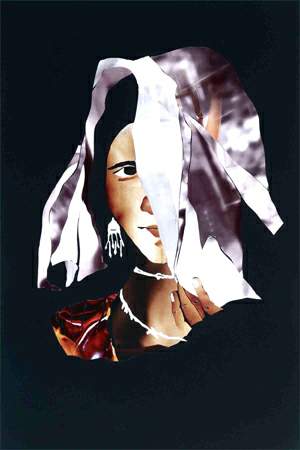
Some Samples of my Paper Collages